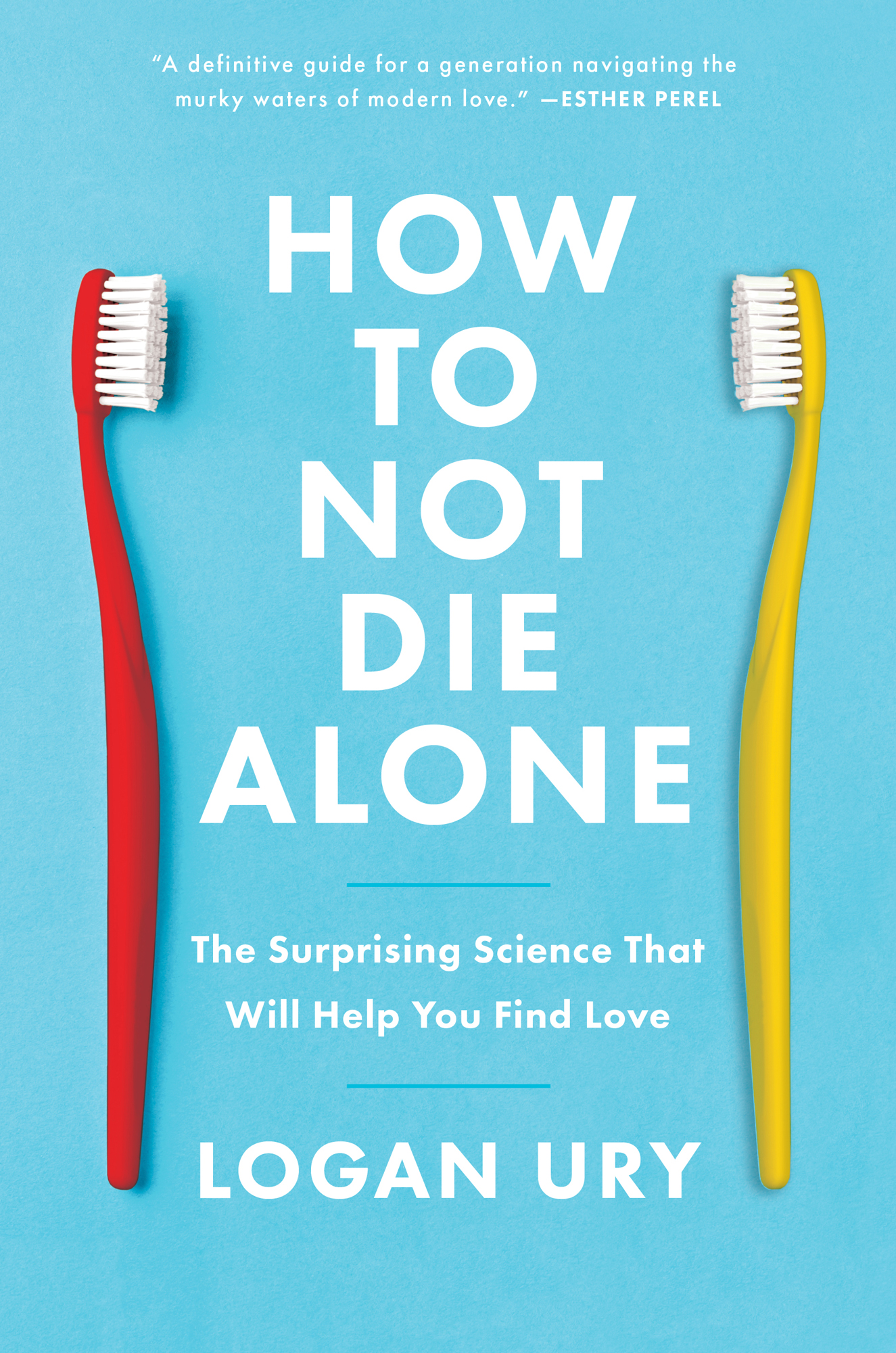
How to Not Die Alone - Logan Ury
## Metadata
- Author: **Logan Ury**
- Full Title: How to Not Die Alone
- Category: #books
## Highlights
- The Romanticizer has unrealistic expectations of *relationships*. They want the soul mate, the happily ever after—the whole fairy tale. ([View Highlight](https://read.readwise.io/read/01k5xxegyravc2j27p6m5d5pdx))
- The Maximizer has unrealistic expectations of their *partner*. They love to explore their options and want to feel absolutely confident they’re making the right decision. ([View Highlight](https://read.readwise.io/read/01k5xxekr4ra1daph2g45k2erm))
- The Hesitater has unrealistic expectations of *themselves*. They feel like they’re not ready to date. ([View Highlight](https://read.readwise.io/read/01k5xxepr5rke45rvpp4da84f3))
- People with soul mate beliefs reject promising partners because they don’t match their vision for what love should look and feel like. They think that love will just happen to them. They expect love to be effortless. If it’s not, they must be with the wrong person. ([View Highlight](https://read.readwise.io/read/01k5y19jph5dkn7zy8grkcp5be))
- People with a work-it-out mindset know that relationships take effort and that building a successful relationship is a process. ([View Highlight](https://read.readwise.io/read/01k5y19mt3r562bhegt42dn73v))
- Maximizers obsess over making the best possible decision. American economist, political scientist, and cognitive psychologist Herbert A. Simon first described this personality profile in a 1956 paper. According to Simon, Maximizers are a special type of perfectionist. They’re compelled to explore every possible option before they feel like they can choose. Yet this compulsion becomes daunting, and ultimately unfeasible, when they face a vast number of possibilities.
On the other end of the spectrum are **Satisficers** (a portmanteau of “satisfy” and “suffice”). They have standards, but they aren’t overly concerned that there might be something better out there. They know their criteria, and they hunt until they find the “good enough” option. It’s not that they settle; they’re simply fine making a decision once they’ve gathered *some* evidence and identified a *satisfactory* option. ([View Highlight](https://read.readwise.io/read/01k5y1kzsv94nh9z448n8y2fch))
- Psychologist and *The Paradox of Choice* author Barry Schwartz explains that what separates Maximizers and Satisficers is not the quality of their decisions, it’s how these decisions make them feel: “Maximizers make good decisions and end up feeling bad about them. Satisficers make good decisions and end up feeling good.” ([View Highlight](https://read.readwise.io/read/01k5z6aqc4kpjwnty9naasw89m))
- During our next session, Doug pulled up his laptop and showed me his work. “Brielle,” he said as the page loaded. “She’s the one.”
“The one? You mean like the *one* the one?” I asked. (I know: I temporarily suspended my distaste for that term.)
“Not the one I’m going to marry, but the benchmark. She was smart, funny, fun to be with, ambitious, and pretty. Ugh, why did I break up with her? Anyway, it’s too late for that. Brielle is my benchmark. I’m going to commit to the next girl who I like as much or more than Brielle.”
Now it’s your turn. To determine your dating window, count the number of years from when you started dating to when you’d like to enter a long-term relationship. Now, what’s 37 percent of that number? Add that to the age when you started dating. That’s your 37 percent mark. If you’re in your thirties, you’ve probably already passed it. Complete the assignment I gave Doug to determine your benchmark partner.
Don’t worry. I’m not telling you to marry the next person you go out with, nor am I implying that it’s too late if you’re past the 37 percent mark. I’m merely suggesting that you likely already have enough data to generate a reasonable, well-informed benchmark. *You do not need more research.* The next time you meet someone whom you like as much or more than that benchmark, commit to them. ([View Highlight](https://read.readwise.io/read/01k5z6rfgr1gxdpxh5j0qnqwv4))
- • Hesitaters delay dating because they don’t feel 100 percent ready yet and want to put their best foot forward. But no one ever feels 100 percent ready for anything. At a certain point, you just have to start.
• Perfection is a lie. Everyone else is imperfect, too—even the person you’ll eventually end up with.
• By waiting to date, Hesitaters miss out on a chance to develop their dating skills and figure out what type of person they want to be with.
• Here’s how you can learn to overcome your hesitation:
• Set deadlines for yourself.
• Do prep work for your new dating life.
• Tell others about your plan.
• Commit to your new identity as a “dater.”
• Start with small goals.
• Be compassionate with yourself.
• STOP TALKING TO YOUR EX! ([View Highlight](https://read.readwise.io/read/01k5z92js49s1em4gd7bb4n72s))
- **Key tip for your dating search**
Don’t worry about finding someone with the same hobbies. It’s fine to enjoy different activities as long as you give each other the space and freedom to explore those hobbies on your own. ([View Highlight](https://read.readwise.io/read/01k5zbnx8azsrmx0zj18ssqqe2))
- 1) Emotional Stability and Kindness ([View Highlight](https://read.readwise.io/read/01k60c2bp5kfj6f5n4zecdkwsq))
- 2) Loyalty ([View Highlight](https://read.readwise.io/read/01k60c2v5ecgktfjwh2v7dhwxb))
- 3) A Growth Mindset ([View Highlight](https://read.readwise.io/read/01k60c316f9dtsjsw0ka81p57r))
- 4) Personality That Brings Out the Best in You ([View Highlight](https://read.readwise.io/read/01k60c37smb801dsd3525y5h2j))
- 5) Skills to Fight Well ([View Highlight](https://read.readwise.io/read/01k60c3er5ebctpqs5b7zyyy3v))
- 6) Ability to Make Hard Decisions with You ([View Highlight](https://read.readwise.io/read/01k60c3qvtwgcx343zm2k1qf82))
- • Who were you in your last relationship? (For example, the pace-setter, pulling your partner along with you? Or the caboose, being pulled? The mentor or the mentee? The one who committed easily or the person who struggled to put down roots?)
• Whom do you want to be in your next one?
• What have you learned about what truly matters in a long-term relationship?
• Moving forward, what will you look for in a partner that you didn’t prioritize this time? ([View Highlight](https://read.readwise.io/read/01k632hc95tw3e57xkk2dc9svb))
- **Conversation #1: The Past**
• What are three moments about your past that you feel define you?
• How do you think your childhood affects who you are today?
• Did your parents fight? What are your fears around relationship conflict?
• What traditions from your family do you want to carry on in our family?
• How did your family talk (or not talk) about sex when you were growing up?
• What did money represent in your family?
• What baggage from your family do you want to leave in the past? ([View Highlight](https://read.readwise.io/read/01k633aenphw3tr7pgf8fy9d38))
- **Conversation #2: The Present**
• Do you feel comfortable talking to me as things come up?
• Is there anything about our communication style that you want to work on?
• Do you feel like you can be yourself in the relationship? Why or why not?
• What changes would you like to make to our relationship?
• How well do you think we handle conflict?
• What’s your favorite ritual that we do together?
• What’s something you wish we did more of together?
• How well do you feel like I know your friends and family? Is there anyone in your life (family, friend, coworker) whom you’d like me to get to know better?
• How often would you like to be having sex? How could our sex life be better? What can I do to improve it? What’s something you’ve always wanted to try but have been afraid to ask for?
• How often do you think about money?
• Let’s talk openly about our finances. Do you have student loans? Credit card debt? Is my debt your debt?
• What’s the most you’d spend on a car? A couch? A pair of shoes? ([View Highlight](https://read.readwise.io/read/01k633asb21cgxeneacmjxv6rn))
- **Conversation #3: The Future**
• Where do you want to live in the future?
• Do you want to have kids? If yes, how many? When? If we can’t conceive on our own, what other options would we consider? Adoption? Surrogacy?
• What are your expectations around splitting child care and housework duties?
• How often do you want to see your family?
• What role do you want religion or spirituality play in our lives?
• Do you want to discuss a prenup? What fears does that bring up for you?
• How do you expect to split finances in the future?
• Do you expect you’ll always want to work? What happens if one of us wants to take time off?
• If I were considering a big purchase, at what point would you want me to call you? (For example, what’s the cutoff for how much I can spend without checking in with you first?)
• What are your long-term financial goals?
• What are you most looking forward to in the future?
• What is a dream of yours for the future? How can I help you achieve it? ([View Highlight](https://read.readwise.io/read/01k633azz4gc5r6ysx1s65gwp2))