Lever vs end user
A mental model for comparing direct help with building capacity to help later, and checking whether the promised benefits reach people.
Helping an end user directly delivers something to the person who needs it. Working on a lever builds capacity intended to help through a tool, organization, funding decision, or another person’s work.
This model compares the distance between an action and its eventual beneficiary. Use it when choosing between a visible contribution now and an indirect contribution that might reach more people later.
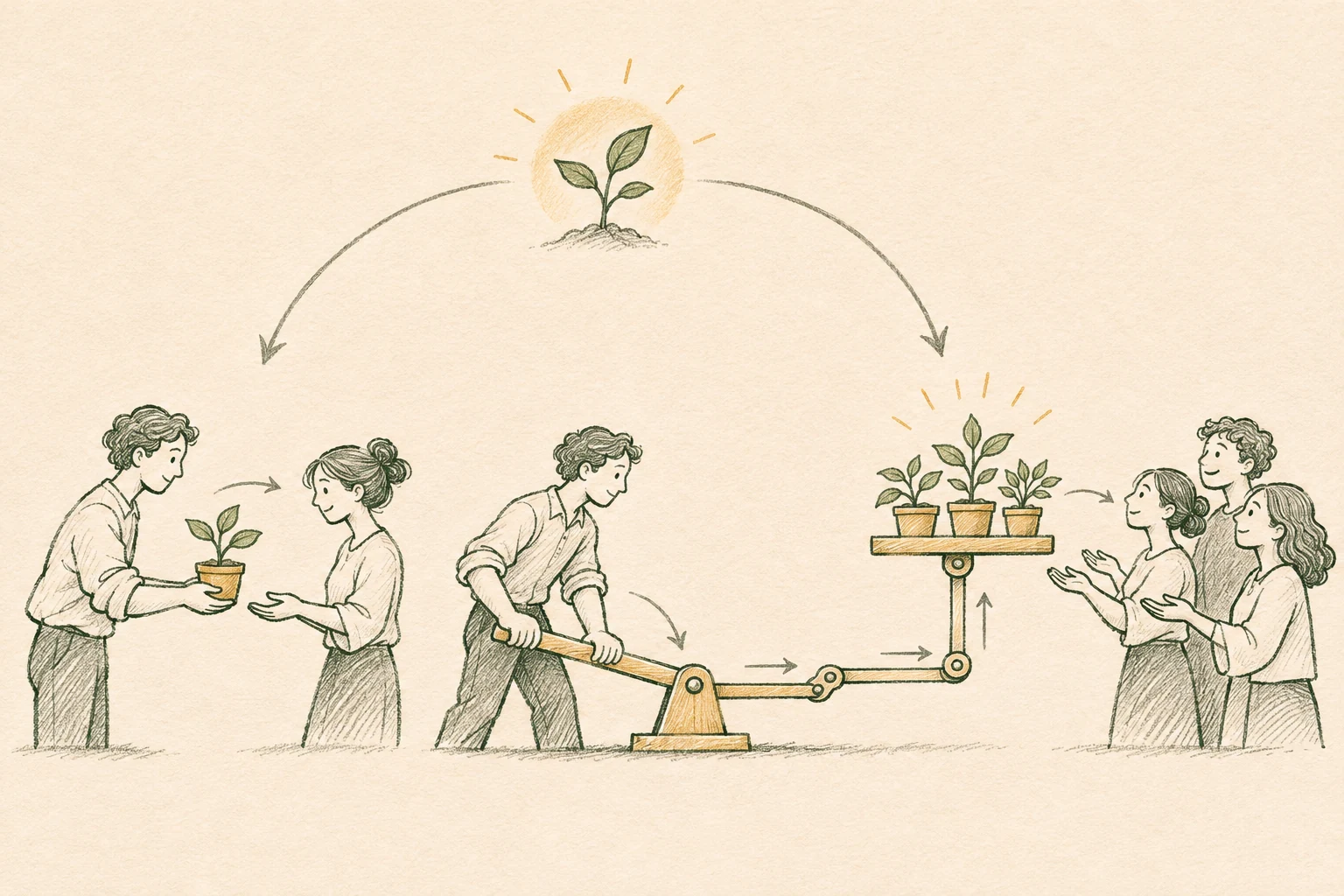
Follow the conversion into benefit
| Approach | How help could reach someone | What could break the chain | What to check |
|---|---|---|---|
| Give a meal or practical help | Someone receives something needed now | The help does not match the need | Whether the recipient can and wants to use it |
| Volunteer in a service | Time contributes to direct care or support | The task adds little or creates extra work | Whether the service needs that contribution |
| Build a useful tool | People use it to accomplish something they care about | Nobody adopts it, or use produces little benefit | Useful outcomes after adoption |
| Build an organization | A team delivers beyond one person’s capacity | Growth increases activity without helping recipients | Whether useful outcomes grow with the organization |
| Invest in a founder | Capital and support enable useful work | The work would happen anyway, or the product causes harm | The difference compared with otherwise available help |
| Earn money to give | Earnings fund someone else’s contribution | Giving is postponed or funds are poorly used | Actual allocation and what it enables |
| Teach or support someone with leverage | An improvement reaches people they serve | Learning never changes behavior or outcomes | Whether the change reaches beneficiaries |
| Develop personal capacity | Better health or skill enables a future contribution | Preparation continues without useful action | Concrete use of the capacity being built |
How to use it
Draw the chain from the action to the person expected to benefit. Name each step: money must be allocated, a tool must be adopted, or a decision must change what happens in practice.
For each step, distinguish evidence from an assumption. A larger possible audience increases potential reach, while a longer chain can add more ways for the benefit to be delayed or lost.
Compare the proposal with what would happen without it. A contribution changes an outcome relative to that alternative. Credit must also be shared when several people or organizations enable the same result.
Choose something observable that would show the chain working: a recipient using the help, a tool improving a task, or funded work delivering a result. The appropriate check depends on the claim; a distant effect may remain uncertain for some time.
Combining the approaches
Direct help and work on a lever can coexist. Direct involvement can reveal actual needs, while tools and organizations can extend delivery. The balance depends on skills, resources, urgency, and evidence.
A large imagined future result should not count as a benefit already delivered. Equally, distance from the beneficiary does not by itself make a contribution worthless. The question is what changes for people and how well that change can be established.
The scalability-of-value table compares illustrative reach and value. This model checks the path from that capacity to an actual outcome.
Mentorship gives a concrete example of helping through another person and checking whether the relationship produces useful changes. Outcome vs output development applies a similar distinction to completed work and the result it delivers.
Further context
Related notes
- Scalability of value essays Potential reach versus the path to a useful outcome.
- Mentorship frameworks Helping one person whose work can help others.
- Outcome vs output development frameworks Check the result delivered rather than the capacity created.
- VC vs entrepreneur notes Different roles in enabling a company’s work.
- Mental model cheatsheet frameworks
Topics